Ruth and Cheryl
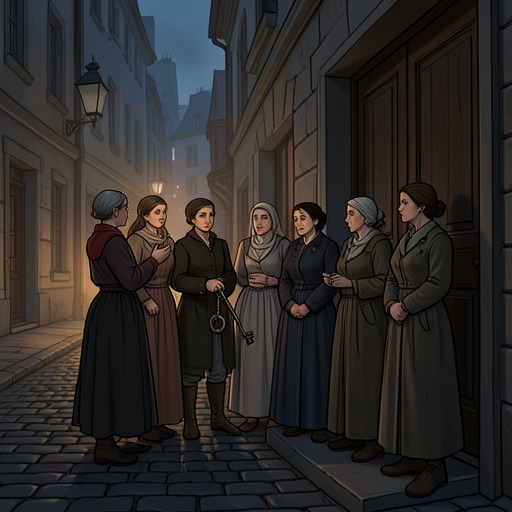
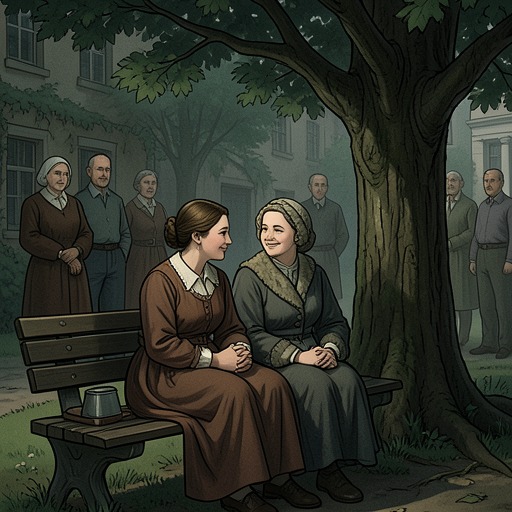
Women TalkingRuth and Cheryl are Greta Loewen’s horses and working team, but in the women’s discussions they become more than an account of animal behavior: their responses to danger and their dependence on a driver’s guidance help frame a dispute over whether leaving Molotschna Colony is fearful flight or a deliberate act of faith. Through Greta’s stories, the horses offer both an image of immediate escape and a test of the women’s competing ideas about instinct, responsibility, and perspective.
Identity and daily circumstances
Greta, the eldest of the Loewen women, describes Ruth and Cheryl as a team whose physical differences matter to their work. Ruth is blind in one eye and must always be harnessed on Cheryl’s left. The detail is practical rather than incidental: the pair travel together under particular conditions, and Greta’s account attends to how they must be arranged as a team.
The horses travel with Greta on the mile road leading to church, where they can encounter one or more of Dueck’s Rottweilers. Greta says that when the dogs frighten them, their first impulse is to bolt. She has seen this happen. Her explanation begins in observed behavior: the horses do not convene or deliberate when danger is near; they run, thereby getting away from the dog and potential harm.
Greta’s analogy of escape
Greta uses Ruth and Cheryl’s response to danger to challenge the women’s lengthy deliberations. If the horses avoid harm by running, she suggests, their example might support an immediate response to the danger the women face. She also describes the women as having been preyed upon like animals, and asks whether they might respond in kind. The analogy is pointed, but it does not erase the difference between the women and the horses: Agata Friesen answers that the women are not animals. The exchange makes the team a contested comparison, not a simple instruction to imitate animal behavior.
Greta returns to the horses when she argues for a different understanding of leaving. She recalls being frightened by the road between Molotschna and Chortiza, which is narrow and bordered by deep gullies. She felt safer only after learning to look far ahead along the road instead of concentrating on the ground immediately before the team. Before that change, her buggy swerved from side to side. Ruth and Cheryl were following her rein commands, but those commands had been jerky and dangerous. In Greta’s account, the horses’ movement reflects the human hand directing them as well as the hazards of the road.
Guidance, instinct, and disagreement
Greta draws a religious and moral conclusion from the road story: leaving could give the women the wider perspective needed to forgive, love properly, and keep peace according to their faith. She presents departure not as cowardice, abandonment, disobedience, or rebellion, but as an act grounded in faith in God’s goodness. The horses are part of the reasoning because the road story joins forward-looking attention to the possibility of traveling safely.
Mejal Loewen tests the analogy rather than accepting it without qualification. She asks whether Ruth and Cheryl would have looked farther down the road or known how to avoid a gully without Greta’s direction through the reins. Her questions bring the driver’s role into focus: the horses’ apparent ability to find a way depends on guidance, not merely on their own instincts. Salome Friesen then challenges the larger implication, questioning whether acting from fear or hunger would itself produce perspective or peace. Greta’s team therefore helps expose a disagreement about what the example can prove: flight can avoid immediate danger, but the road story also suggests that safety requires direction and foresight.
A recurring measure in the women’s debate
The horses return as a familiar example even when the discussion turns to the limits of the analogy. Greta asks the women to imagine Ruth and Cheryl asking to be left alone in a field to graze and do nothing. Agata counters with her own animal example, imagining hens asking her to leave rather than gather their eggs. The comparison shifts from animals’ instinctive escape to human responsibility for the animals in their care. It makes the proposal of simply doing nothing seem inadequate within the debate, while also showing how frequently the women test abstract choices against ordinary relationships with animals.
Ruth and Cheryl also help illuminate the narrator’s later comparison of thirteen- and fourteen-year-old boys to yearlings: young, awkward, powerful, and in need of direction. That parallel does not make the horses responsible for the dangers being discussed. Instead, it reinforces the distinction between capacity and guidance: youthful energy can cause harm, but children can be taught. Across these discussions, the horses’ significance rests in concrete details—the harnessing, the frightened flight, the hazardous road, and Greta’s reins—through which the women examine both the urgency of escape and the care required to choose a way forward.